



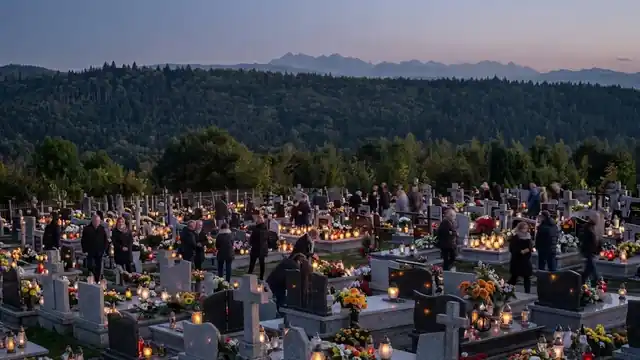
Every 1 November, a country of 38 million people gets in the car, drives to a cemetery and lights a candle. Then another. Then, collectively, several million more. This is the story of Poland's quietest, strangest, most beautiful holiday, and the one your family probably never explained to you.
If you fly into Warsaw on the evening of 1 November and look down, you will see something that is not on any tourist map. Scattered across the dark are patches of orange light, soft and flickering, the size of a few city blocks. Those are cemeteries. Every one of them is glowing.
On the ground it is stranger still. Whole families in good coats, three generations deep, stand around a granite slab at nine o'clock at night. Nobody is crying. Grandmother is adjusting a candle. A teenager is being told, for the fourth time, which great-uncle this is. At the gate, stalls sell candles and flowers late into the evening, and the extra buses run full.
This is Wszystkich Świętych (VSHIST-kih SHVYEN-tih), All Saints' Day, and it is the biggest holiday in Poland that nobody outside Poland has heard of. Christmas has more presents. Easter has more pagan baggage. But nothing else moves the whole country at once, and nothing else is so entirely, un-self-consciously about the people who came before you.
For a reader of Polish descent, that last part matters. This holiday is, at its core, about the exact thing you are doing when you dig out a grandparent's birth record: standing at a grave and saying, I know who you were.
Two days, two names: Wszystkich Świętych and Zaduszki
Poles talk about "Wszystkich Świętych" as if it were one day. Technically it is two, and they are not the same thing.
1 November, All Saints' Day, honours every saint in heaven, known and unknown. It is a public holiday: shops close, schools close, the motorways fill. The Church set it on this date back in the eighth and ninth centuries, and for most of history it was the cheerful one of the pair. Saints are, after all, the success stories.
2 November, All Souls' Day, is Dzień Zaduszny, or simply Zaduszki (zah-DOOSH-kee). This is the day for everyone else: the ordinary dead, the ones still on their way. Catholic tradition holds that the living can help those souls along with prayer, and so Zaduszki is the day of Masses for the departed and lists of names read from the pulpit. It is not a public holiday, which is precisely why Poland quietly shifted the cemetery visit to the day off.
The result is a hybrid. Officially, the 1st is about saints. In practice, the 1st is when everyone visits grandma's grave, and the 2nd is when the more devout go back to pray. Ask a Pole which day is which and you may get a pause. Ask them where they will be on the evening of the 1st and the answer comes without hesitation: at the cemetery, with family.
The Church gave Poland a feast for saints. Poland made it the day families gather around their own.
Before the candles: Dziady and the Slavic feast of the dead
Long before anyone in Poland had heard of All Saints, the Slavs already had a night for the dead. It was called Dziady (JAH-dih), literally "the grandfathers" or "the forefathers".
Dziady came several times a year, but the autumn one, after the harvest, was the big one. The belief was simple: on that night the souls of ancestors came home. They were cold and hungry, and it was the family's duty to welcome them.
The customs, as folklorists later recorded them, show how seriously that duty was taken:
- Food was left out. Kasza, honey, eggs, bread and vodka were set on the table or carried to the graves, sometimes with a place laid for the departed.
- Fires were lit. Bonfires burned at crossroads and near cemeteries so wandering souls could warm themselves and find their way home.
- The house was handled carefully. In some regions you did not sweep, spin or pour water out the door that night, in case you hit a visiting soul.
- A guide was hired. In parts of the eastern borderlands, a village elder, the guślarz, led the rites and called the dead by name.
The Church spent centuries trying to suppress these rites and in the end largely absorbed them. The monk Odilo of Cluny established All Souls' Day around the year 1000, and over time the ancestors' night slid neatly into the Christian calendar. The food on the graves became Masses for the dead. The bonfires at the crossroads became candles on the graves.
That is why the image of a glowing Polish cemetery is so old. The candles are not decoration. They are, quite literally, a light left on for someone coming home.
Dziady never fully disappeared, either. In 1823 Adam Mickiewicz turned it into Dziady (Forefathers' Eve), the play that became the cornerstone of Polish Romantic drama. In 1968 the communist authorities closed a Warsaw production because audiences cheered the anti-Russian lines a little too loudly, and the protests that followed became a political crisis. An ancient night of remembrance had become a symbol of the nation itself.
The great migration: how the whole country moves on 1 November
In most countries, people visit their dead when they feel like it. In Poland, everyone visits on the same weekend, and they will drive across the country to do it.
The reason is the Polish family map. After the war, the borders moved west, millions were resettled, and later millions more left villages for cities or for Chicago, London and Dublin. Families scattered. The graves stayed put. So every year around 1 November, Poland performs a giant reverse migration: from Warsaw back to the village near Rzeszów, from Wrocław back to the town where grandparents first arrived from the East, from London back to anywhere at all.
The logistics are serious. Police run a road-safety operation every year and publish the accident figures afterwards, the way other countries do for Christmas. Cities add bus lines that exist for one weekend only, running from the centre straight to the cemetery gates. By the afternoon of the 1st, the roads around large cemeteries are full.
The route is planned like a campaign. Mum's side in the morning, Dad's side after lunch, the in-laws' parish before dark, and a stop at the grave of the neighbour who had no one left. Many families visit four cemeteries in a single day so that no one is left out.
Nobody calls it a pilgrimage. It is just what you do on the 1st.
Znicze: the candle economy
The Polish grave candle is called a znicz (zneech; plural znicze), and it is not a candle in any sense a Western reader would recognise. It is a sturdy glass jar, often coloured, with a metal lid full of holes, built to burn through wind, rain and the first snow of November. A good one lasts days. A premium one lasts a week.
From mid-October, znicze appear everywhere. Supermarkets stack them by the entrance in pallets. Stalls outside every cemetery gate sell them alongside flowers, lighters and spare inserts. The range is broad: plain red glass for a few złoty, tall engraved lanterns, models with angels, models with crosses, and, in recent years, battery-powered LED versions, which many older Poles still consider no substitute for a real flame.
Colour carries a little meaning, though nobody enforces it. Red is the classic. White and clear are common. Some families keep a colour per person, so you can tell from the gate which grave is whose.
The etiquette is unwritten but firm:
- You light one on your family's graves. That is the minimum.
- You light one on graves that have none. A dark, forgotten grave on the evening of the 1st is something few Poles will walk past.
- You do not blow out anyone else's. If the wind does it, you relight it.
- You keep your voice down. It is a family gathering, but it is also a place of prayer.
On the night of 1 November the result is the scene from the plane window: thousands of small red flames per cemetery, all burning at once, the air smelling of wax and cold chrysanthemums. Polish poets have spent two hundred years trying to describe it. Most visitors simply fall silent.
Chrysanthemums, scrubbing and the family inspection
The candles get the photographs, but the real work happens a week earlier, with a bucket.
In the last days of October, Polish cemeteries fill with people cleaning. They scrub the granite, pull weeds, sweep away leaves, polish the brass letters and repaint the railings on older plots. It is done seriously, because a well-kept grave is a visible sign that someone still remembers.
Then come the flowers, and in Poland that means chrysanthemums, chryzantemy. Potted, never cut, because they need to survive the cold for weeks. Markets near cemeteries turn into fields of yellow, white, burgundy and rust in late October. In most of Western Europe chrysanthemums are a garden flower. In Poland, they belong so completely to the cemetery that few people would think of giving them as a gift.
And then there is the conversation at the grave, which is its own institution. While the candles are arranged, the family catches up. Who married whom, who is sick, who finally moved back from England. Older relatives use the moment to pass on the family map: this is your great-grandmother, she came from near Lwów; that one over there is the uncle who never came back from the war. For many Poles, this is where they first learned their own family history, standing on gravel in the cold, being told who was who.
It is genealogy, done the old way. No archive required, just a grandmother with a good memory and a reason to talk.
Graves without families: Powązki, soldiers and strangers
The most Polish thing about 1 November may be what happens at graves that belong to nobody in particular.
Walk through any large cemetery and you will see candles on plots where no relative has come in decades. Someone passed, saw a dark grave and fixed it. Scout troops tidy forgotten graves as a matter of routine. War graves get special attention: the soldiers of 1920, the insurgents of 1944, the partisans in village cemeteries. Their stones carry rows of candles that no single family put there.
In Warsaw the centre of all this is Stare Powązki, the old cemetery founded in 1790 where generations of Polish writers, composers, actors and soldiers are buried. Since 1975, on 1 November, well-known actors, journalists and public figures stand at the gates with collection tins. This is the kwesta (KVES-tah), started by the music critic Jerzy Waldorff to pay for restoring the cemetery's crumbling monuments. Collectors stand in the cold for hours, and the money has saved hundreds of historic tombs. Other cities have copied it, and today a kwesta at the cemetery gate is part of the day across Poland.
The kindness also goes abroad. Poles travel to the old Polish cemeteries in Lviv and Vilnius, where the borders moved but the graves did not, to light candles for people their country once included. At the Rasos cemetery in Vilnius, a black granite slab covers the grave of Józef Piłsudski's mother, with his heart buried beside her. On 1 November it disappears under candles.
And at Polish war cemeteries from Monte Cassino to Arnhem, local Poles, and often their non-Polish neighbours, keep the znicze burning. Nobody is left to ask them to. They just do.
Halloween in Poland: a newcomer on the night before
Halloween falls on 31 October, the evening before Wszystkich Świętych. In Poland that timing turned a borrowed party into a long-running debate.
Halloween reached Poland in the 1990s, along with much else from the West. Today it is visible mainly in big cities: costume parties in clubs, pumpkins in shop windows, themed events at schools and nurseries, and a modest amount of trick-or-treating in newer housing estates. For many young Poles it is simply a night out, and few see any harm in it.
For others the timing is the problem. On the evening when Americans dress up as skeletons, a Polish family may be packing candles and chrysanthemums into the car for a long drive to the family grave. Celebrating death as a costume theme the night before remembering your own dead can feel, to many Poles, out of place.
The Catholic Church in Poland has been openly critical, and many parishes now offer an alternative. On the evening of 31 October, children dress as their favourite saints instead of monsters and walk in processions or attend parties called Bal Wszystkich Świętych (the All Saints' Ball) or Holy Wins. So in a single Polish town on the same night, you might see a small witch and a small St Francis on the same street.
What Halloween has not done is change 1 November. However the 31st is spent, the next day the cemeteries fill exactly as they always have. In that sense the two holidays barely meet. Halloween is a party about death in general. Wszystkich Świętych is about particular people, by name, in a particular place.
Why it means something different in the diaspora
For Poles abroad, 1 November comes with a particular difficulty: the graves are somewhere else.
Polish communities have answered that in their own way. In Chicago, London, Toronto and elsewhere, Polish parishes hold Masses for the dead in early November and read out long lists of names submitted by parishioners, many of them buried thousands of kilometres away. Families light a znicz at home, by a photograph, or at the grave of the first generation who emigrated. In some cities, Polish cemeteries and Polish sections of larger ones glow on 1 November just as they do in Kraków.
For the grandchildren and great-grandchildren of emigrants, the day can raise a different question. You may know a great-grandmother's name and roughly where she came from. You may have no idea where she is buried, whether anyone still lights a candle there, or whether the village still has the same name.
That is where All Saints' Day and family history meet. The customs at the grave, the names read aloud, the stories passed on over the candles, all exist to keep a family's line of memory unbroken. Tracing that line back through parish books and civil records is, in a quieter way, the same act. It is how many people of Polish descent first find the town their family came from, and sometimes the grave, too.
If you do find it, there is only one proper thing to do on 1 November. Light a candle there, or ask someone in Poland to light one for you. People do this for strangers' graves every year. For a family returning after a century, it means a great deal more.
Frequently asked questions
Is All Saints' Day a public holiday in Poland?
Yes. 1 November is a statutory day off, and most shops are closed. All Souls' Day (Zaduszki) on 2 November is a normal working day.
What is the difference between Wszystkich Świętych and Zaduszki?
Wszystkich Świętych (1 November) honours all the saints. Zaduszki, or Dzień Zaduszny (2 November), is the day of prayer for all the faithful departed. In practice, most Polish families visit their family graves on the 1st, because it is the day off.
What are the candles on Polish graves called?
They are called znicze (singular znicz): glass lanterns with a lid, designed to burn for days outdoors. They descend in spirit from the fires lit for the dead during the pre-Christian Slavic Dziady.
Do Poles celebrate Halloween?
Some do, mainly in cities and among younger people, but it remains a minor and somewhat contested import. Many parishes offer an All Saints' Ball for children on 31 October instead.
Can I visit a Polish cemetery on 1 November as a tourist?
Yes, and visitors are welcome. Dress warmly and modestly, keep your voice down, and don't photograph mourners up close. Bringing a znicz to light on a forgotten grave is a gesture Poles will understand.
I'm of Polish descent. How can I find where my ancestors are buried?
Start with what you have: names, approximate dates and the town or parish of origin. Parish and civil registry records in Poland usually record the place of death, and from there the local cemetery. The same records are the foundation of any confirmation of Polish citizenship application, so the search can serve more than one purpose.
