




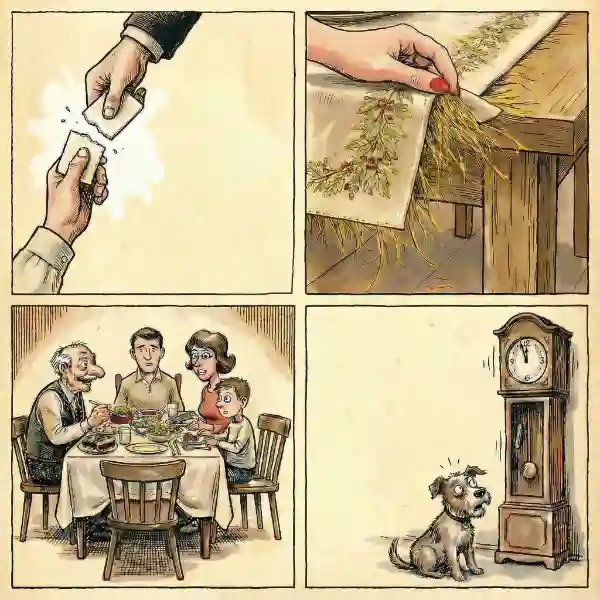
If you think your family's Christmas traditions are quirky, wait until you hear about Polish Christmas. This is a country where your dinner might predict your entire year's fortune, where deceased relatives are expected to pop in for a visit, and where—if you listen closely enough at midnight—your dog might finally tell you what he really thinks about those dried-out kibbles you've been serving him.
Welcome to Wigilia (pronounced vee-GHEE-lyah), the magical, mystical, and magnificently superstitious heart of Polish Christmas.
The Great Star-Watching Competition
In Poland, Christmas Eve dinner doesn't start when grandma says it's ready. It doesn't start when the food comes out of the oven. No, dinner begins when the first star appears in the evening sky—the Gwiazdka, representing the Star of Bethlehem that guided the Wise Men.
This means every Polish household features children glued to windows, desperately scanning the heavens while their stomachs growl. Cloudy Christmas Eve? Better hope those kids have good imagination skills, because dinner is being held hostage by astronomy. The competition to spot it first is fierce—bragging rights last until at least the next holiday.
It's basically Poland's biggest December sport. And unlike football, everyone's a participant.
Breaking Bread (Sort Of): The Sacred Opłatek Ritual
Before anyone touches any of the twelve dishes (yes, twelve—we'll get to that), there's the opłatek ceremony. This thin, unleavened wafer—similar to communion bread and pressed with holy images—is the emotional centrepiece of the evening.
Here's how it works: each family member takes turns breaking off a piece of another person's wafer while exchanging wishes for health, happiness, and prosperity in the coming year.
This isn't a quick "cheers" situation. In traditional families, you might spend twenty minutes or more working your way around the table, making heartfelt wishes to each person, often with tears and embraces. It's a moment of genuine reconciliation—grudges are forgiven, old wounds acknowledged, and everyone enters the meal with a clean slate.
It's like an edible hug for the soul.
Regional Twists on Opłatek
- In Podhale (the Tatra Mountains), the wafer is dipped in honey first—sweetness for the coming year and reconciliation between family members. The smell of fir, hay, and honey is apparently unforgettable.
- In Wielkopolska, after returning from Midnight Mass, families would head to the stable to share opłatek with their cows and horses. The animals were present at Jesus's birth; they deserve good wishes too.
- In the countryside, some families still offer a piece of wafer to their pets. After all, if animals can talk at midnight (more on that later), they should probably get Christmas wishes too.
Warning: Don't drop the opłatek. In old traditions, dropping your wafer during the exchange was considered a very bad omen—some claimed it meant death within the year. No pressure!
The Empty Chair: A Place for Ghosts, Strangers & Insurance
Every Polish Christmas table features one extra place setting—an empty chair with a full plate and cutlery—for the "unexpected guest." On the surface, this represents hospitality: if a lonely traveller or stranger knocks on your door, they already have a seat waiting.
But the tradition runs deeper. In Poland's pagan past, this extra setting was meant for deceased ancestors, who were believed to return home on this magical night. Families would leave food out for these visiting spirits and even bang pots and pans after dinner to usher them back to the otherworld. (Apparently ghosts respond well to loud noises.)
Over time, the meaning softened—today it's also a way to remember loved ones who can't be present, whether due to distance, circumstance, or death. During Poland's turbulent history of wars and partitions, that empty chair often held special poignancy: a place set for family members who might, just might, make it home for Christmas.
There's also a practical superstition at play: the number of diners should be even. An odd number at the table foretells that someone won't make it to next Christmas. That extra chair ensures you're covered either way.
Generosity, remembrance, and insurance against cosmic bad luck—all in one empty seat.
Hay Under the Tablecloth: Humility Meets Fortune-Telling
Every properly set Wigilia table has a layer of hay or dried grass tucked beneath the white tablecloth. This commemorates Jesus's birth in a humble manger—a reminder that the most important things in life aren't fancy or expensive. It ties modern Poland back to fields, farmhouses, and simpler times.
But naturally, Poles found ways to make the hay useful beyond symbolism.
The Marriage Fortune Game 💍
In some regions, young women would reach under the tablecloth and pull out strands of hay to predict their romantic futures:
- 🟢 Green strand = Marriage before Mardi Gras (start planning the wedding!)
- 🟡 Yellow strand = You'll have to wait a bit longer
- ⚫ Black strand = Eternal spinsterhood (absolutely no middle ground here)
In Mazovia, the hay under the tablecloth carries special significance as a tribute to Mary's humility in the stable. Some families keep hay in the corners of their home throughout the year for good luck. Because if you're going to have dried grass lying around, it might as well be magical dried grass.
Superstitions: When Your Entire Year Hangs in the Balance
Poles take the phrase "Jaka Wigilia, taki cały rok" ("As goes Christmas Eve, so goes the whole year") very, very seriously. This means Christmas Eve comes with a pressure level usually reserved for job interviews, first dates, and defusing bombs.
The Golden Rules of Wigilia
Master these, and you might just survive the year:
Don't argue.Fighting on Wigilia means a year of quarrels. Even if your uncle makes that comment about your job again, smile and reach for more pierogi. Your future self will thank you.
Even number of guests.Odd numbers at the table foretell bad luck—or worse, that someone won't live to see next Christmas. Hence the empty chair. Mathematics has never been more stressful.
Don't leave before midnight.Sneaking out early? That's inviting misfortune to follow you home. You're committed until the clock strikes twelve. No exceptions for introverts.
Settle all debts beforehand.Enter Christmas Eve with zero financial obligations. Carrying debt into Wigilia supposedly prophesies a year of poverty. (Your credit card company might disagree with this timing, but tradition is tradition.)
Don't lend anything from the house.Giving away items on Christmas Eve might mean giving away your luck for the entire year. Your neighbour needs sugar? Tell them to wait until December 26th.
Don't clean up after dinner.At least in Lower Silesia, tidying up was believed to sweep away good fortune. Finally, a superstition everyone can enthusiastically embrace. "Sorry, can't do dishes—it's bad luck!"
Hide the sharp knives.In Podhale, ancestors' spirits were believed to visit on Christmas Eve. Sharp knives left out might injure them. Plus, you don't want to "cut" your good luck. Butter knives only.
Weather Prophecies
Because obviously the sky has opinions about your future:
- Snow on Christmas Eve? Thick white blankets mean rich harvests next year.
- Rain? Drought is coming. Start hoarding water.
- Clear skies? Only the prettiest girls will get married. (Yes, really. No, we don't make the rules.)
The Morning After
The superstitions don't end at midnight:
First person through the door on Christmas morning matters. If a man crosses the threshold first, good luck follows. If a woman enters first... well, better luck next year. (We're just reporting the folklore here, not endorsing it.)
Midnight Magic: When Animals Learn to Talk
Here's perhaps the most charming (and slightly unnerving) Polish Christmas tradition: at midnight on Christmas Eve, animals are granted the power of human speech.
The story goes that animals were given this gift to celebrate Jesus's birth in a stable—they needed to spread the good news, after all. Some say the tradition has older, pagan roots, where ancestors communicated through living creatures on the winter solstice.
The Catch (There's Always a Catch)
In older versions of this belief, eavesdropping on animal conversations was forbidden because they might reveal the date of your death. In some highland regions, listening to the animals was said to cause blindness.
Your cat probably has opinions about you anyway. Maybe it's better not to know.
Today, the tradition has mellowed—families might offer their pets a piece of opłatek wafer and see if Fluffy has anything to say about the quality of this year's kibble. Results are typically... inconclusive.
"When I was little, I had a dog, and at midnight on Christmas Eve I would always try to start a conversation with him. Unfortunately, it was always pretty one-sided."— A Polish Christmas tradition survivor
Forget Santa: Poland Has a Whole Cast of Gift-Givers
While most of the world waits for one jolly man in a red suit, Polish children might receive gifts from an entirely different character depending on where they live. Poland's centuries under various foreign powers (Prussian, Russian, Austrian) left a patchwork of regional traditions that makes the gift-giving situation... complicated.
Children are often told to be extra quiet during dinner so they don't scare away whichever mysterious figure is responsible for the gifts appearing under the tree. The idea of one universal Santa is actually a relatively recent American import.
The Gwiazdor Experience
The Gwiazdor deserves special mention because he's not entirely... friendly. Unlike jolly Santa, the Star Man:
- Wears a sheepskin coat turned inside out (intimidating fashion choice)
- Carries a stick for children who misbehaved
- Might demand you recite prayers or sing carols before receiving gifts
- Allegedly checks the cleanliness of your shoes
It's less "ho ho ho" and more "prove yourself worthy." Character-building, really.
⛪ After Dinner: Kolędy and Pasterka
Once the last dish is finished (all twelve of them—you did try everything, right?), the traditions continue well into the night.
Singing Kolędy 🎶
Polish Christmas carols (kolędy) are legendary—some date back to the medieval period, though the most beloved ones come from the baroque era. Families gather around the table or the tree to sing together, often for an hour or more.
The greatest hits include:
- "Bóg się rodzi" (God Is Born) — One of these almost became the national anthem
- "Wśród nocnej ciszy" (Amid the Silence of the Night)
- "Lulajże Jezuniu" (Sleep, Little Jesus)
- "Dzisiaj w Betlejem" (Today in Bethlehem)
According to surveys, nearly 80% of Poles sing carols at the Christmas dinner table. That's not a tradition—that's a national choir.
In the countryside, groups of carollers (kolędnicy) still go door to door, sometimes performing short nativity plays (jasełka) in exchange for treats or small coins. In Podhale, they sing pastorałki—folk Christmas songs in the highlander dialect that sound like nothing else in Poland.
Pasterka — Midnight Mass
Many families end Christmas Eve by attending Pasterka (Shepherd's Mass) at midnight. It commemorates the shepherds who came to witness Jesus's birth. Churches are packed, carols echo through candlelit naves, and it's often the most atmospheric mass of the entire year.
Coming home from Pasterka through snow-covered streets, with the echo of carols still in your ears and your breath visible in the cold air? That's the stuff Christmas memories are made of.
(Also a good time to check if the animals have started talking yet.)
The Unofficial Tradition: Home Alone
And finally, no article about Polish Christmas would be complete without mentioning the unlikely official-unofficial tradition: watching Home Alone (Kevin sam w domu).
Since the 1990s, Polish television has broadcast the film every Christmas season, and it's become so embedded in the culture that Poles joke there's no Christmas without Kevin McCallister outsmarting burglars. The film airs multiple times throughout the holidays—sometimes several times on the same day across different channels.
Many families have made watching it part of their post-dinner ritual, right alongside singing kolędy and opening presents. At this point, Macaulay Culkin is basically an honorary Polish Christmas figure, somewhere between Gwiazdor and Dziadek Mróz.
Some traditions take centuries to form. This one took about a decade and a VHS tape.
Why It All Matters
Polish Christmas traditions are a magnificent collision of deep Catholic faith, ancient Slavic paganism, regional pride, and the kind of superstition that makes you count your dinner guests three times while nervously checking the weather forecast.
It's not about perfection—it's about touching threads of centuries-old culture that make every star, wafer, and empty chair feel alive with history. It's about reconciliation through opłatek, hope through the first star, and community through traditions that have survived wars, partitions, and communist rule.
And yes, it's also about not arguing with Uncle Janusz even when he's being impossible, because you really don't want a year of quarrels.
Wesołych Świąt!
Curious about what actually goes on those twelve plates? Check out our guide to Polish Christmas Cuisine: A Regional Tour of the Wigilia Feast — where fish swim in bathtubs, poppy seeds mean prosperity, and every region has its own delicious opinions.
Written for those discovering Polish traditions.
