




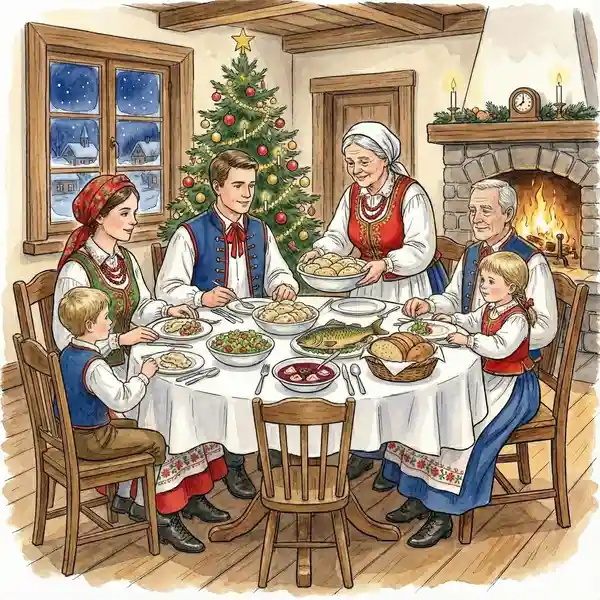
If you've heard that Polish Christmas Eve dinner involves twelve dishes, you might think: "That's a lot of food." And you'd be right. But what you might not realise is that those twelve dishes aren't just a lot of food—they're a culinary journey through centuries of tradition, regional rivalry, and the kind of creative problem-solving that happens when you need to feed a family of fifteen without using any meat.
Welcome to the Wigilia feast—where every bite has meaning, every region has opinions, and somewhere, a carp is swimming in someone's bathtub, blissfully unaware of its fate.
The Rules of the Game: Twelve Dishes, No Meat, No Excuses
Before we dive into the delicious details, let's establish the ground rules of the Wigilia table:
1. Twelve dishes. Representing either the twelve apostles or the twelve months of the year (Poles can't quite agree, but everyone agrees on eating). Some families do seven, nine, or eleven—always an odd number for good luck. But twelve is the gold standard.
2. You must taste every single one. Skipping a dish? That's basically inviting bad luck to move into your spare bedroom and stay for the whole year.
3. No meat. Christmas Eve in Poland is strictly pescatarian (fish is fine) plus vegetables, mushrooms, grains, and enough poppy seeds to make you wonder if bakeries secretly run the country. This goes back to old Catholic fasting traditions.
4. No leftovers should remain. Finishing everything on the table was considered good luck. (Finally, a tradition that encourages seconds.)
The reasoning behind the meatless rule is partly religious (Advent fasting) and partly practical—in the old days, meat was precious and saved for Christmas Day. But honestly, after navigating twelve dishes of fish, pierogi, soups, and poppy seed everything, you won't miss the ham.
The Greatest Hits: Dishes You'll Find Almost Everywhere
While every family and region has their own lineup, certain dishes appear on Wigilia tables from the Baltic coast to the Tatra Mountains:
Barszcz z Uszkami (Beet Soup with "Little Ears")
This ruby-red beet soup, clear as garnet and served with tiny ear-shaped mushroom dumplings, is the opening act of most Wigilia dinners. The dumplings are called uszka ("little ears") because... well, look at them.
Making uszka is a meditative pre-Christmas activity (or a family argument waiting to happen, depending on your household dynamics). Some families spend entire afternoons pinching hundreds of these tiny dumplings closed while discussing who made them better last year.
Pro tip: Some families hide a coin in one of the uszka. Whoever finds it will have fortune smiling on them all year. Just... chew carefully.
Zupa Grzybowa (Mushroom Soup)
Rich, earthy, and intensely aromatic—this soup is made from dried forest mushrooms foraged in autumn. Poles take mushroom foraging very seriously. It's practically a competitive sport, with secret spots passed down through generations and heated debates about whether borowiki or podgrzybki make the superior soup.
This is what the forest tastes like in liquid form. Usually served with thin square noodles (łazanki) or small dumplings.
Pierogi z Kapustą i Grzybami
Dumplings stuffed with sauerkraut and mushrooms—the vegetarian superstar of the evening. Every grandmother has her own recipe, every family believes theirs is the best, and nobody is wrong.
Some families make hundreds of these in the days leading up to Christmas, freezing batches and arguing about the proper thickness of the dough. (Too thick = peasant food. Too thin = they'll fall apart. There's a Goldilocks zone that takes years to master.)
Karp (Carp)
The controversial king of the Polish Christmas table. Breaded and fried, baked with vegetables, or prepared po żydowsku (Jewish-style, with almonds, raisins, and a sweet-sour sauce)—carp is the centrepiece around which the entire meal revolves.
But before the carp reaches your plate, it might have spent a few days swimming in your bathtub. Yes, really. More on that delightful tradition below.
Śledź (Herring)
No Wigilia is complete without herring, usually prepared in at least two or three ways:
- In oil with onions
- In cream sauce
- In vinegar with vegetables (śledź w oleju, śledź w śmietanie, śledź marynowany)
Herring is particularly beloved in the northern regions near the Baltic coast, where it's practically a food group unto itself.
Ryba w Galarecie (Fish in Aspic)
Love it or hate it, this jiggly creation appears on nearly every traditional table. Carp or pike suspended in savoury gelatin, decorated with carrots and parsley, looking like something from a 1970s cookbook.
It's divisive. Some consider it the height of Christmas elegance. Others quietly push it around their plate hoping no one notices. But it's tradition, and tradition means eating the wobbly fish.
Kluski z Makiem (Noodles with Poppy Seeds)
Sweet noodles or dumplings drenched in ground poppy seeds, honey, and sometimes raisins or walnuts. Poppy seeds symbolise abundance and wealth—the more seeds, the more prosperity in the coming year.
This dish walks the line between main course and dessert, appearing somewhere in the middle of the meal to give everyone a sugar boost for the remaining six dishes.
Kutia
A sweet, porridge-like dish of wheat berries (or barley), poppy seeds, honey, and walnuts. It's especially beloved in eastern Poland, where Lithuanian, Belarusian, and Ukrainian influences shaped the Christmas table.
Sharing kutia within the family circle is meant to ensure good harvest and abundance. It tastes like someone combined breakfast, dessert, and a blessing into one bowl.
Kompot z Suszu (Dried Fruit Compote)
The traditional drink of Wigilia—a sweet, slightly smoky beverage made from stewed dried apples, pears, plums, and sometimes apricots. It's meant to aid digestion after you've eaten approximately forty-seven dishes.
The tradition of kompot z suszu actually originated in Mazovia (the region around Warsaw), and now it appears on tables nationwide. It tastes like Christmas distilled into liquid form.
The Carp in the Bathtub: A Love Story (Sort Of)
Perhaps nothing confuses outsiders more than the Polish tradition of buying a live carp days before Christmas and keeping it swimming in the family bathtub.
Yes, the bathtub you bathe in. Yes, the same carp you'll later eat.
The Logic (There Is Some)
The origin is practical: in the pre-refrigerator era, this was simply how you kept fish fresh. The theory was that the bathtub water would help purge any muddy taste from the bottom-feeding fish. Whether this actually works is debatable—as is how happy the fish might be after a few days of family members popping in to "check on him."
The Emotional Complications
Children often become attached to these temporary pets. They give them names (Karpuś is popular). They talk to them. They form bonds.
This leads to the occasional Christmas morning miracle where the fish is quietly released into a nearby river rather than becoming dinner. Dad says the fish "escaped." Everyone pretends to believe him.
The Modern Reality
The practice has declined in recent decades. The Supreme Court banned selling live fish without water in 2016, and more families opt for pre-filleted carp from the supermarket. But you can still find bathtub carp in many households, carrying on a tradition that's equal parts practical and wonderfully absurd.
The Scales (Don't Throw Them Away!)
Here's the important part: save those carp scales. Tucking a scale into your wallet is believed to attract money all year long.
Some older ladies reportedly tuck them into their bras during dinner for extra luck. Now that's commitment to financial prosperity.
Regional Specialties: A Culinary Road Trip
Here's where it gets really interesting. Different regions of Poland take the same Christmas spirit and flavour it with fierce local pride. Think of Poland as several delicious countries wearing a trench coat, each convinced their Wigilia is the best.
Podhale (The Tatra Mountains)
The highlanders don't do subtle. Christmas Eve in Podhale is bold, hearty, and tastes like the mountains.
Signature Dishes:
Moskole — Thick potato pancakes made with sheep's cheese (bryndza or bundz). Crispy on the outside, pillowy inside, and absolutely not found anywhere else in Poland. The highlanders guard this recipe like treasure.
Kwaśnica — Sour cabbage soup, but make it vegetarian for Christmas Eve. Made with sauerkraut and dried forest mushrooms, it's tangy, warming, and allegedly excellent for digestion (which you'll need after dish number eight).
Fried Trout — The mountains have streams. The streams have trout. The trout end up breaded and fried to golden perfection. Much less controversial than bathtub carp.
Makówki — Layered poppy seed dessert that's almost architectural. Bread or rolls layered with poppy seed paste, honey, and sometimes nuts. In Podhale, poppy seeds symbolised abundance and connection with ancestors. Double meaning, double delicious.
Regional Quirk: In Podhale, the opłatek wafer is dipped in honey before sharing. And instead of (or alongside) a Christmas tree, traditional homes hung a podłaźniczka—a fir branch from the ceiling—as a talisman against evil.
Silesia (Śląsk)
Silesians have strong opinions about everything, including Christmas food. Their Wigilia table features dishes you won't find anywhere else in Poland.
Signature Dishes:
Siemieniotka — A creamy soup made from hemp seeds. Yes, hemp. It's smoky, slightly nutty, and allegedly ensures fertility. Uniquely Silesian, and visitors either love it or stare at it suspiciously.
Moczka — Forget borscht. Silesia has moczka—a thick, dark, impossibly rich dessert-soup made from gingerbread soaked in dark beer, with dried fruits, chocolate, nuts, and plums. It's so decadent it could replace Christmas pudding entirely. It shouldn't work, but it absolutely does.
Makówki — Like Podhale, but the Silesian version involves layers of wheat rolls soaked in warm milk, then smothered in poppy seed paste. Eaten warm. Dangerously good.
Cabbage with Peas — Kapusta z grochem. Simple, humble, and on every Silesian table. Sometimes mocked by other regions, fiercely defended by Silesians.
Carp Stewed in Beer — Because Silesia.
Regional Quirk: Silesians avoid cleaning up after Christmas Eve dinner—sweeping might sweep away good fortune. Also, borrowing or lending anything around Christmas was seriously frowned upon. Give away your salt? You might be giving away your luck for the year.
Wielkopolska (Greater Poland)
The Poznań region brings order, elegance, and a certain refined confidence to the Christmas table.
Signature Dishes:
Almond Soup — Zupa migdałowa. Starting dinner with this creamy, slightly sweet soup is meant to prophesy wealth for the coming year. It's like drinking luxury. (Some families serve it with raisins and rice, others keep it pure.)
Makiełki — Wielkopolska's answer to poppy seed noodles. Small pasta shapes (or broken communion wafers) mixed with poppy seed mass, honey, and dried fruit. Richer and more complex than the simpler versions found elsewhere.
Pierogi z Kapustą — The Wielkopolska version tends toward refined simplicity. Properly made, properly folded, properly delicious.
Ryba po Poznańsku — Fish "Poznań-style"—often carp baked with vegetables in a way that Wielkopolska insists is superior to all other preparations. (They may be right.)
Grey Dumplings — Szare kluchy. Potato dumplings that are a year-round staple here, appearing on the Christmas table with mushroom sauce.
Regional Quirk: After Midnight Mass, Wielkopolska families traditionally head to the stable to share opłatek with their cows and horses. The animals were present at Jesus's birth; they deserve Christmas wishes too.
Mazovia (Mazowsze)
The region surrounding Warsaw is forest country, and the cuisine reflects those deep, mushroom-filled woods.
Signature Dishes:
Forest Mushroom Soup — The definitive version. Made from dried borowiki (porcini) foraged in autumn, this soup is deep, earthy, and intensely aromatic. Mazovians will tell you their mushroom soup is the standard against which all others should be measured. They're not entirely wrong.
Kompot z Suszu — The tradition of dried fruit compote actually originated here. That sweet, smoky drink everyone serves? You can thank Mazovia.
Ryba w Galarecie — Fish in aspic is particularly associated with Mazovia. Carp or pike suspended in savoury gelatin, decorated with carrots and parsley. It's the jiggly hallmark of Mazovian Christmas.
Rwaki — Unique dumplings made from boiled potatoes, torn by hand (the name means "torn things"), and served either savoury with cabbage and mushrooms or sweet with poppy seeds. Very Mazovian, rarely seen elsewhere.
Kutia — Also popular here, especially in families with eastern roots.
Regional Quirk: The hay under the tablecloth carries special significance in Mazovia as a tribute to Mary's humility in the stable. Also, if it snows on Christmas Eve, old Mazovian lore says thick white blankets mean rich harvests for the coming year.
Podlasie (Eastern Borderlands)
Eastern Poland's Christmas carries Lithuanian, Belarusian, and Ukrainian influences—this is where East meets West on the dinner plate.
Signature Dishes:
Kutia — The undisputed queen of the Podlasie Christmas table. Wheat berries (or barley), poppy seeds, honey, and walnuts, sometimes with raisins. Sharing kutia within the family circle ensures good harvest and abundance. This is the dish here—everything else is supporting cast.
Mushroom Borscht — Instead of the classic red beet borscht, Podlasie often serves a darker, mushroom-based version. Earthy, intense, and absolutely perfect on a cold December night.
Wareniki — Similar to pierogi but fried until crispy golden brown. Stuffed with cabbage and mushrooms, then pan-fried until the edges are crunchy. Worth the extra step.
Savoury Donuts — Yes, really. Podlasie serves donuts stuffed with cabbage and mushrooms. Pączki z kapustą. Not sweet, not a typo, and surprisingly delicious. Don't knock it until you've tried it.
Pierogi with Potatoes — The Podlasie version often includes fried onions in the filling, adding extra richness.
Regional Quirk: Eastern influences mean some families include dishes with buckwheat, sour cream, and preparations that would seem unfamiliar in western Poland. The crossroads of cultures makes for a uniquely diverse table.
Kashubia (Kaszuby)
The northern coastal region has its own proud identity, shaped by the Baltic Sea and fierce independence.
Signature Dishes:
Brzad — A unique dried fruit soup that starts the meal instead of borscht. Sweet, warming, and distinctly Kashubian.
Sieja — Local whitefish from Lake Łebsko, fried with mushroom sauce. Kashubians prefer their own freshwater fish over the "controversial" carp that dominates elsewhere. Ask a Kashubian about carp and watch them politely change the subject.
Herring Everything — Various preparations of Baltic herring: in oil, in cream, pickled, with onions, with beets. If it involves herring, Kashubia has a version.
Fish Soup — Made from whatever the sea and lakes provide. Simple, fresh, and deeply local.
Regional Quirk: Kashubia maintains its own language (not just a dialect—an actual Slavic language) and fiercely distinct identity. Their Christmas table reflects this: familiar in structure, unique in details, and absolutely not to be confused with "regular" Polish food.
The Complete Wigilia Table: A Summary
Here's what a "typical" Wigilia might include (though no two families are exactly alike):
Why All This Food Matters
Polish Christmas cuisine isn't just about eating well (though it absolutely is). Every dish carries meaning: poppy seeds for prosperity, honey for sweetness in the coming year, fish for fertility and luck, grain for abundance.
The twelve dishes represent a full year of hoping, planning, and praying that next December will find everyone healthy, happy, and together again around the same table.
And yes, it's also about regional pride. Ask a Silesian and a Kashubian whose Christmas food is better and prepare for a very polite argument that has been ongoing for approximately 400 years.
The best part? There's no wrong way to do it. Every family's Wigilia is correct, every grandmother's pierogi are the best, and every region has something unique to offer.
Just don't forget to try all twelve dishes. Your luck depends on it.
Smacznego! 🥂
Want to know about the traditions and superstitions surrounding this feast? Read our guide to Polish Christmas Traditions: Wigilia Rituals & How Not to Jinx Your Year — where animals talk at midnight and your entire future hangs on not dropping the opłatek.
Written for those discovering Polish culinary traditions
