



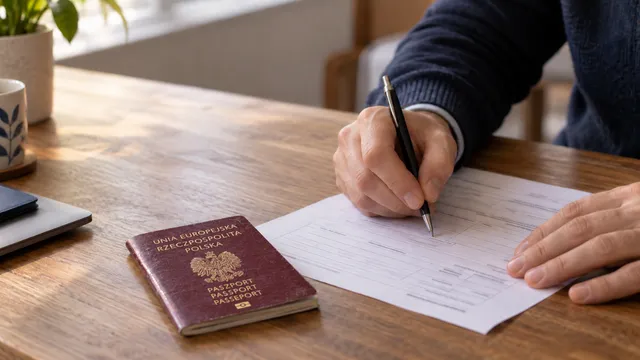
Most passports stop working on the date printed inside. A Polish passport can stop working earlier, 120 days after a change of your data in the PESEL registry, and the printed date says nothing about it. This article covers the full lifecycle: how long the document is valid, what ends that validity early, how renewal really works, and your two routes home if it is lost or stolen.
TL;DR: A Polish passport is valid for 10 years, or 5 years for children under 12. A change of your data in the PESEL registry, most often a surname change after marriage, invalidates it 120 days later regardless of the printed date. Renewal in the everyday sense does not exist: it is a new application, in person, with new biometrics and a new fee. If the passport is lost or stolen abroad, there are two routes home: a Polish temporary passport from a career consulate, or the EU Emergency Travel Document from another EU country's consulate, in force since 9 December 2025.
How long a Polish passport is valid
Three numbers cover every case. A passport issued to anyone aged 12 or older is valid for 10 years. A child under 12 receives a passport valid for 5 years. A temporary passport is valid for the period needed, up to a maximum of 365 days. The printed expiry date is the ceiling, not a guarantee, and the next section is about the one rule that can end validity years early. What the document does for you while it is valid is the subject of our main Polish passport article.
The 120-day rule that invalidates a valid passport
The rule is short and almost never quoted: the passport is invalidated 120 days after a change of the holder's data in the PESEL registry, whatever the expiry date in the document says. The data covered are the surname, name or names, date of birth, sex, and the PESEL number itself.
The most common way this happens is a surname change after marriage. The sequence matters for people abroad. The change reaches the PESEL registry when your marriage is registered in the Polish records, so transcribing your marriage certificate is often the very act that starts the 120 days. The document does not change in your drawer, no letter arrives, and the border system knows before you do.
What to do about it is simple, if unglamorous. If your registry data has changed, treat your current passport as a document with 120 days left and book the new application at once. The renewal process below is the same one, and the appointment queue eats calendar time, so the 120 days are less generous than they sound.
Renewal at a consulate is a new application
Polish law has no renewal in the everyday sense: no stamp, no extension, no postal top-up. When a passport expires, or the 120-day rule ends it, you submit a new application in person at a career consulate. That means new fingerprints, a new photo no older than six months, and a new fee. Bring the current passport, valid or not, because it is presented at the application and cancelled when you collect the new one. The fees and the market-by-market table are in the cost section of the application article.
The one advantage over a first application: your Polish records already exist. No confirmation procedure, no transcription, no PESEL step, just the application itself, which is why a renewal is measured in weeks rather than months.
When to start counting backwards
Production takes about 6 to 8 weeks at consulates such as those in the UK or Canada, and about a month in Poland. On top of that sits the wait for an appointment slot in e-Konsulat, which is not published anywhere and can outlast the production itself. Our recommendation: start no later than 4 to 5 months before your passport expires.
There is a second clock people forget. Many countries require your passport to remain valid 3 or even 6 months beyond your planned departure, so a passport with five months left is already too short for some destinations. The real renewal deadline is not the expiry date. It is the expiry date minus your destination's validity requirement, minus the queue.
Lost or stolen: the first 24 hours
Three moves, in order. Report the loss or theft to the local police and keep the report, because the consulate will ask about the circumstances and the report anchors your story. Contact the nearest Polish consulate, by phone or email before you travel to it, and say clearly whether you have urgent travel ahead. Gather whatever identity evidence you still have: any other document with your name, a copy or photo of the lost passport, your PESEL number if you know it. The consulate can verify who you are against Polish registries, so a lost passport does not mean a lost identity, it means paperwork.
A reported passport is invalidated, so if it later turns up in a jacket pocket, it does not come back to life and travelling on it is not an option. From here, there are two routes to a travel document, and they are the subject of the next two sections.
Polish temporary passport (paszport tymczasowy)
The temporary passport is Poland's own emergency document, and it exists for three situations: while you wait for a biometric passport, when fingerprints cannot be taken, and in urgent cases. The rules describe the urgent cases as illness, family matters, return to your place of residence, work, or a child's schooling. It is valid for the period needed, up to 365 days, and only a career consul can issue it. An honorary consul cannot.
The fee depends on when you need it: 24 USD as the standard rate, 59 USD in the expedited cases the fee table names, 118 USD outside office hours, and 235 USD on a non-working day. The after-hours rates are the price of a genuine emergency service, and knowing they exist is worth something at 11 pm in an airport.
One warning that comes from the Polish foreign ministry itself: not every country admits travellers on a temporary passport, so check acceptance with your destination or transit country before you fly. A temporary passport gets you home reliably. It does not promise to get you everywhere.
The EU Emergency Travel Document: live since December 2025
This is the newest document in the Polish traveller's toolkit, and it belongs to every EU citizen. Since 9 December 2025, Directive 2019/997 has been in force, replacing the patchwork that operated since the 1990s with a single, uniform EU Emergency Travel Document. The concept is simple. If your passport is lost, stolen or destroyed in a country where Poland cannot help you, another EU member state's consulate issues you a document for the trip home.
The parameters come straight from the directive. The ETD covers a single journey to your country of citizenship or residence. Its validity covers the journey plus a small margin, in practice usually within 15 days, and the processing target is 7 working days. The issuing state cannot charge you more than it charges its own citizens for the equivalent document.
Who qualifies: an EU citizen who is "unrepresented" where they are. The definition is wider than it sounds: it covers not only countries without a Polish post, but also those where a Polish post exists and genuinely cannot help. What that right rests on, and how to check who would assist you before you travel, is set out in the consular section of our ranking article.
EU ETD vs a Polish temporary passport
EU ETD vs a Polish temporary passport
| Polish temporary passport | EU Emergency Travel Document | |
|---|---|---|
| Who issues it | A Polish career consul | Another EU member state's consulate |
| When it applies | Loss, urgent cases, waiting for a biometric passport | You are unrepresented: no Polish post, or one genuinely unable to help |
| Validity | Up to 365 days | One journey, in practice usually within 15 days |
| Where it takes you | Onward travel possible, but some countries do not accept it | Home: your country of citizenship or residence |
| Cost | From 24 USD, up to 235 USD out of hours | No more than the issuing state charges its own citizens |
For holders of other passports, the equivalents are narrower. A US citizen gets an emergency passport from a US embassy. A UK citizen gets a UK emergency travel document, which allows transit through a maximum of 5 countries and requires having held a passport issued after 1 January 2006. Canada and Australia issue their own emergency travel documents through their posts. None of these can be issued by another country's consulate, which is the quiet structural advantage the EU ETD represents: 26 other countries' posts can document a Polish citizen's trip home.
Key takeaways
- Validity is 10 years from age 12, 5 years under 12, and up to 365 days for a temporary passport.
- A change of your data in the PESEL registry invalidates the passport 120 days later, and a surname change after marriage is the most common trigger.
- There is no renewal in the everyday sense: a new application, in person, with new biometrics and a new fee.
- Start 4 to 5 months before expiry, and remember many destinations require 3 to 6 months of validity beyond your trip.
- Lost abroad, you have two routes home: a Polish temporary passport from a career consul, or the EU Emergency Travel Document from another EU state's consulate, in force since 9 December 2025.
Where to start
If your own passport is due for renewal, the steps above are the whole map. The question worth asking alongside it is whether everyone in your family is documented at all. A spouse or child with a claim to Polish citizenship has a longer road than a renewal, and starting both together saves months. A free assessment answers the family side in one step. And if someone in your family has never had their citizenship confirmed, that procedure is explained in our article on confirming Polish citizenship by descent.
Check your eligibilityFrequently asked questions
How long is a Polish passport valid?
Ten years for anyone aged 12 or older at issue, and 5 years for children under 12. A temporary passport is valid for the period it was issued for, up to a maximum of 365 days. The printed date is a ceiling, not a promise: a change of your data in the PESEL registry invalidates the passport 120 days after the change, whatever the document says.
Does a name change invalidate my Polish passport?
Yes, on a timer set by the Passport Documents Act of 2022 (art. 74): once the change of your name reaches the PESEL registry, the passport loses validity 120 days later. The same 120-day rule covers changes of first names, date of birth, sex, and the PESEL number. For people abroad, the change typically reaches the registry when the marriage certificate is transcribed into the Polish records. If that has happened, treat your passport as expiring in 120 days and book a new application without waiting.
Can I renew my Polish passport by mail or online?
No, and holding a passport before changes nothing: Polish law has no shortened procedure for renewals. It is a new application in person, with new fingerprints and a new photo, because the biometrics cannot be carried over from the old document. Bring the expiring passport to the appointment, as it is presented there and cancelled when you collect the new one. What renewal does spare you is everything that comes before: no citizenship confirmation, no transcription, no PESEL step, which is why it is measured in weeks rather than months.
What if my Polish passport expired years ago?
An expired passport does not end your citizenship, so the route back is a new application rather than any restoration procedure. Bring the expired document: it remains evidence of your identity and citizenship. If your records have changed since it was issued, a marriage or a move for example, the consulate will tell you which registry updates need to happen first.
What happens if you lose your passport overseas?
Report it to the local police and contact the nearest Polish consulate. Then choose the route that fits: a Polish temporary passport where a Polish career consul can act, or the EU Emergency Travel Document where Poland has no reachable post. The reported passport is permanently invalidated, so finding it later changes nothing. For dual citizens, the other passport is often the fastest document, and the choice of which to use is a practical one.
What is the EU Emergency Travel Document and how fast can you get one?
It is a single-journey document any EU member state's consulate can issue to an unrepresented EU citizen, in force since 9 December 2025 under Directive 2019/997. The processing target is 7 working days, the validity covers the journey home plus a small margin, in practice usually within 15 days, and the issuing country cannot charge you more than its own citizens pay for the equivalent. It replaced a patchwork that had operated since the 1990s, so it is new enough that few travellers know it exists.
How do you reach a consulate if your passport is gone?
Start with a phone or email, not a journey: consulates confirm what they need before you travel to them, and in a genuine emergency they advise on the fastest path. A police report and any remaining document with your name carry you through most domestic travel to reach the post. Where the nearest Polish post is unreachable in practice, another EU country's consulate can act instead.
