



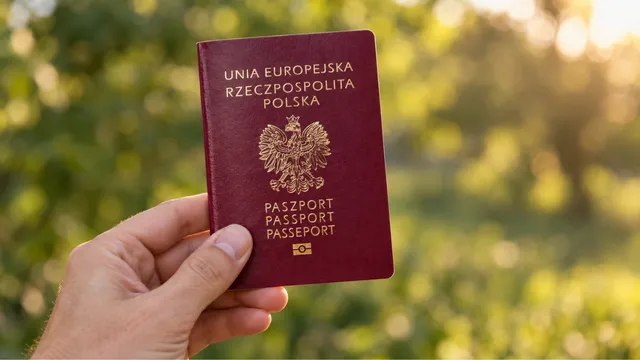
The Polish passport ranks sixth in the world in the July 2026 edition of the Henley Passport Index, ahead of the American, Canadian and Australian ones. The more practical questions sit elsewhere: what the document actually does for you, and how you would get one while living in Chicago or Melbourne. This article covers both, section by section, with a detailed article behind each stage.
TL;DR: If an unbroken family line connects you to a Polish citizen, you most likely hold Polish citizenship already, and the passport is the document that confirms it. Poland ranks 6th in the world with 184 visa-free destinations (Henley Passport Index, July 2026), ahead of the US, Canada and Australia. Applying from abroad is a fixed four-step chain: citizenship confirmation, transcription of your birth certificate, PESEL number, then the passport itself, at 140 PLN in Poland or 165 USD at a US consulate. It stays valid for 10 years, with one trap worth knowing: a data change in the PESEL registry ends that validity after 120 days.
Do you already qualify for a Polish passport by descent?
Polish citizenship passes by blood, from parent to child, wherever the child is born, and it did not stop passing when your family emigrated. If an unbroken line connects you to a Polish citizen, you are most likely a Polish citizen already. The state confirms what has been true since your birth rather than granting anything new. The passport is simply the document that proves it, and the confirmation procedure is where every case starts.
How strong is it?
Poland ranks 6th in the world with 184 visa-free destinations in the July 2026 Henley Passport Index, level with the United Kingdom and ahead of Australia, Canada and the United States. Other indexes count destinations differently, so you will meet other numbers online. On both major indexes, Poland places ahead of the US. What sits behind these numbers, and why the counts disagree, is covered in the article on how strong the Polish passport really is.
What it lets you do
Three things. First, the right to live and work across the European Union: unconditional for the first three months, then conditional on work, study or sufficient means, and permanent after five years of residence. Second, exemption from the EU's new border systems. Third, access to the consulates of 27 states instead of one. Since 10 April 2026 the Entry/Exit System registers non-EU travellers at Schengen borders, and ETIAS will add a paid travel authorisation once it launches. A Polish passport sits outside both. One honest exception: the UK's Electronic Travel Authorisation applies to Polish citizens as well, so the passport removes no barrier there. What these rights change in daily life, beyond travel itself, is covered in the article on the 13 benefits of confirming Polish citizenship.
The four steps, in the order they have to happen
For anyone applying from abroad who has never held a Polish document, the application is a chain of four steps, and the order is not optional:
- Confirmation of Polish citizenship, decided by a voivode (the head of a regional government office in Poland), with the application submitted through your consulate.
- Transcription of your foreign birth certificate (and marriage certificate, where your current name comes from it) into the Polish civil registry.
- A PESEL number, Poland's personal identification number, requested at the passport appointment itself rather than in advance.
- The passport application, made in person at a consulate, with fingerprints taken on the spot and collection in person as well.
Each step feeds the next: without the transcription there is no PESEL, and without a PESEL there is no passport. The step-by-step article walks through all four, with the documents and fees for each.
Do you also need a Polish ID card?
No, and for most readers of this article the passport is the realistic choice anyway. Poles living permanently abroad have no obligation to hold a dowod osobisty (the Polish ID card), and the passport fully documents both identity and citizenship. The practical difference is where each is issued. A passport is available through your consulate, while an ID card is issued only by offices in Poland: the application and the collection both happen there in person, and the government confirmed in 2026 that consular ID applications are not planned. If you visit Poland, it is worth picking one up while you are there. It is free, any office in the country accepts the application, and within the EU it works as a travel document on its own.
What it costs
An adult passport costs 140 PLN when issued in Poland and 165 USD at a Polish consulate in the United States. The consular base fee is 140 EUR, converted locally. Consular fees rose on 1 January 2026, the first change in roughly a decade. The full fee tables, the reduced rates for children, and the costs that come before the passport itself are in the cost section of the application article.
How long it's valid, and when it expires early
A Polish passport is valid for 10 years for anyone aged 12 and older, and 5 years for younger children. There is one trap worth knowing about. A change of your data in the PESEL registry, most commonly a surname change after marriage, invalidates the passport 120 days later, even if the printed expiry date is years away. How the rule works, and what to do when it applies to you, is covered in the renewal article.
If it's lost or stolen
Report the loss and contact the nearest Polish consulate. From there, two routes lead home: a Polish temporary passport, or the EU Emergency Travel Document, issued by another EU country's consulate when no Polish post can realistically help. The EU document is new, in force since 9 December 2025, and few travellers know it exists yet. What to do in the first 24 hours, and how the two documents compare, is in the renewal and replacement article.
Key takeaways
- If your family line is unbroken, you are most likely a Polish citizen already. The passport confirms that status rather than creating it.
- Poland ranks 6th with 184 destinations in the July 2026 Henley index, ahead of the US, Canada and Australia.
- The application from abroad is a fixed four-step chain: citizenship confirmation, transcription, PESEL, passport.
- Consular fees changed on 1 January 2026, so cost figures published earlier are out of date.
- A passport is valid for 10 years, but a data change in the PESEL registry can end that validity after 120 days.
Where to start
If you are wondering whether your family line qualifies, that is the natural first question, and it is one that can be answered quickly. Start with a free assessment and you will learn where you stand and which of the four steps applies to you. There is no rush and no commitment. When you are ready, we are here.
Check your eligibilityFrequently asked questions
Is a Polish passport worth it?
For most eligible people, yes, and for a simple reason: it is the only widely available document that carries the right to live, work and study across the European Union. If you qualify through ancestry, the citizenship is confirmed rather than applied for. The fees are modest compared with any residence or investment route. The main investment is patience with paperwork rather than money.
Who can get a Polish passport?
Any Polish citizen, and Polish citizenship passes by descent: from parent to child, across generations, regardless of birthplace. The one condition is that the line was not interrupted by one of the historical events that caused loss of citizenship. Many descendants of Polish emigrants hold citizenship today without knowing it. Whether your line qualifies depends on dates, documents and a few historical rules, which is exactly what a case assessment checks.
Where does Poland's passport rank in 2026?
Sixth in the world in the Henley Passport Index, July 2026 edition, with 184 visa-free destinations. The Passport Index by Arton places Poland fifth under its own methodology. The two indexes count differently, which is why different numbers circulate online, but Poland places ahead of the United States on both.
Should I get my child a Polish passport?
If your child is a Polish citizen, a passport gives them the same EU rights for their whole life, and childhood is administratively the simplest time to put the documents in order. A child's passport requires the consent of both parents and the child's presence at the appointment. It is valid for 5 years below the age of 12 and for 10 years from 12, which is also the age when fingerprints are first taken. The practical steps for a child born abroad are described in the application article.
If you have dual citizenship, which passport do you use at the border?
The general rule: each country expects its own citizens to enter on its own passport. A Polish-American traveller therefore shows the US passport at the US border and the Polish one in Poland and the Schengen area. Getting this wrong can have real consequences for how your days in Europe are counted. The border scenarios, including the trap that catches dual citizens, are covered in the ranking and travel article.
Is a Polish passport better than a US passport?
On mobility numbers, yes: both major passport indexes place Poland ahead of the United States in 2026, and the US has moved from 1st place in 2006 to 10th today. The more meaningful difference lies elsewhere: a Polish passport carries residence and work rights across 27 countries, which no ranking measures. Most dual citizens simply carry both and use each where it is strongest.
How long does it take to get a Polish passport?
The passport itself typically takes about a month when issued in Poland, and around 6 to 8 weeks at consulates such as those in the UK or Canada. On top of that comes the wait for an appointment slot, which is not published anywhere. If you first need citizenship confirmation and transcription, plan in months rather than weeks for the whole chain. No statutory deadline is published for the confirmation decision. Counting backwards from a planned trip is the safest way to plan.
Do I have to travel to Poland to get a Polish passport?
No. The entire chain can run through a Polish consulate in your country of residence. The citizenship confirmation application is submitted through the consul, the transcription can be handled the same way, and the passport application and collection happen at the consulate. What you cannot avoid is appearing in person at the consulate itself, because fingerprints are taken on the spot.
Can I keep my current citizenship?
Poland does not ask you to give anything up: Polish law tolerates dual citizenship, with one condition worth knowing. Before Polish authorities you are treated exclusively as a Polish citizen and cannot rely on your other passport (Article 3 of the Polish Citizenship Act). Whether your other country permits dual citizenship is a separate question. The US, UK, Canada and Australia all do.
What does Polish citizenship give you beyond travel?
Travel is the visible part, and often the smallest one. Citizenship also affects where you can study at domestic tuition levels, how your healthcare works when you move within the EU, and what passes automatically to your children. The full picture is in the article on the 13 benefits of confirming Polish citizenship.
