




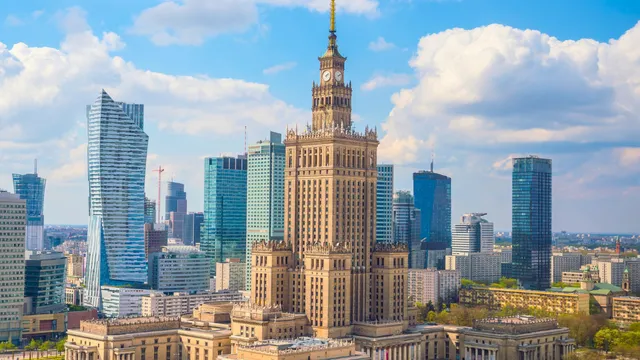
A Polish passport opens two doors at once. One leads to Poland itself, a real option if you're drawn to living there, and a growing job market in its own right. The other leads to the rest of Europe: the right to live and work across most of the continent, with no visa and no employer sponsorship. Some people are set on Poland. Others want the freedom to work across the EU and beyond. Either way, this is what citizenship actually unlocks for your career. And work is just one piece of it: see the full list of 13 benefits of Polish citizenship.
TL;DR: A Polish passport gives you the right to work in all 27 EU countries, plus Norway, Iceland, Liechtenstein, and Switzerland. No work permit, no sponsorship. You also gain Europe's basic worker rights, like paid leave and capped hours set by law. Poland itself has a growing job market, especially in IT. And you can use these rights without leaving your remote job, though tax residency needs care.
What does an EU passport actually let you do for work?
It lets you work in any EU country without a permit or sponsorship. That's the core of it.
Free movement of workers is one of the EU's core freedoms. As a Polish citizen, you're an EU citizen. You can move to Germany, Spain, or Ireland and take a job there. No visa. No quota. No employer needing to prove they couldn't find a local first.
This is a bigger deal than it sounds. Ask any American who's tried to work abroad. The usual wall is sponsorship. A company has to sponsor your work visa. That's slow, costly, and it narrows who will even look at you. EU citizens skip that entirely. You apply for jobs on the same footing as a local.
You also get equal treatment. That means the same pay rules, the same work terms, and the same access to public benefits as locals.
What are workers' rights and work-life balance really like in Europe?
European jobs come with a legal floor. It often surprises North American workers. Guaranteed paid leave and capped hours are the headline.
The EU Working Time Directive sets the baseline. Every worker gets at least four weeks of paid annual leave, which is 20 days for a full-time job. The average working week is capped at 48 hours, including overtime. You're also entitled to 11 hours of rest in every 24, plus at least 35 hours of unbroken rest each week, usually the weekend.
Family leave is another area where Europe sets a strong floor. Under EU rules (Directive 2019/1158 and Directive 92/85), every member state must guarantee at least:
- Maternity leave: 14 weeks, paid at least at the national sick-pay rate.
- Paternity leave: 10 working days for fathers or second parents.
- Parental leave: 4 months per parent. At least 2 months can't be passed to the other parent, and must be paid.
- Carers' leave: 5 working days a year to care for a relative or someone in your household.
- Flexible work: the right to request flexible hours, for parents of children up to age 8 and for carers.
Countries often go beyond these floors. So what you actually get depends on where you work.
Here's the thing: that's the floor, not the ceiling. Many countries go further. France caps the standard week at 35 hours. Spain requires 30 calendar days of annual leave. Some rules are left entirely to each country, too. Overtime pay is one. Poland, for example, adds a 50% premium on a normal working day, and 100% on Sundays, public holidays, and night work.
For someone used to the US system, this is a real shift. There's no federal law guaranteeing paid vacation in the US, and many jobs are at-will. Job security works differently in Europe. In most EU countries, letting someone go needs a clear, on-record reason. It also needs a notice period. There's no real at-will employment. Health insurance is usually tied to your job in the US. Europe's model trades some of that freedom for security and time off.
Is it all upside? Not quite. Headline salaries in much of Europe run lower than US levels, especially in tech. More on that below. But for a lot of people, the balance is the whole point.
Is Poland itself a good place to work?
For some profiles, yes, especially in IT, finance, and shared services, where experience from abroad is an asset.
Poland's business services sector has grown into a serious hub. ABSL tracks this sector each year. That's the Association of Business Service Leaders, Poland's main industry body for it. Its Business Services Sector in Poland 2025 report puts employment at around 488,700 people in early 2025, up 6.2% from the year before. That's across more than 2,000 service centers run by over 1,250 companies. The sector now makes up about 5.7% of Poland's GDP.
Most of these are global firms. Foreign-owned centers make up roughly 84% of the jobs. The newest centers lean heavily toward IT and R&D. So if you work in software, data, finance, or engineering, your skills travel well here.
The main hubs are Warsaw, Kraków, and Wrocław. But Poland isn't really one job market. It's several cities, each with its own focus. So the useful question isn't "Poland or not?" It's "which city fits my work?" Here's how the six big hubs compare.
| City | Known for | Typical gross pay/month | Who it suits |
|---|---|---|---|
| Warsaw | Finance, consulting, corporate HQs | PLN 9,500–10,500 (highest) | Senior finance, legal, and corporate roles |
| Kraków | Tech and shared services; deep US-firm presence | PLN 8,000–9,000 (tech higher) | Software, AI, and business-services pros |
| Wrocław | Engineering, automotive, R&D | PLN 8,500–9,500 | Engineers who want strong value for money |
| Gdańsk (Tri-City) | Maritime, fintech, gaming, coastal life | PLN 8,500–9,200 | Fintech and game developers who want the coast |
| Poznań | Automotive, logistics, manufacturing | PLN 7,800–8,800 | Industrial and supply-chain specialists |
| Rzeszów | Aerospace ("Aviation Valley") | PLN 6,800–8,000 (low living costs) | Aerospace and defense engineers |
Salary ranges from recruitment-industry reports (Employsome, Motife, Alcor, KiTalent), 2025–26. Treat them as directional, and confirm with a local recruiter.
A few are worth a closer look. Warsaw is the biggest and broadest market. It's the capital, and the country's finance and corporate center. Most global firms run their regional head offices here. That gives it the deepest pool of senior roles, and the highest pay, roughly 20–30% above the national average. The catch is cost: rent and daily life are the priciest in Poland.
Kraków is the clearest fit for US tech workers. It's a major tech and shared-services hub, home to around 108,000 service-center jobs. Better still, about 40% of its IT talent already works for US firms like Google, IBM, and Motorola. So you can work for a US company without ever moving there.
Rzeszów is the surprise. It's a small city, but it anchors "Aviation Valley," a cluster of more than 150 aerospace firms. Pratt & Whitney alone employs over 4,450 people there. They build engine parts for jets like the F-16 and F-35. If your background is aerospace or defense, your skills carry over almost directly.
Wrocław is the value pick for engineers. Pay runs close to Warsaw and Kraków, but rent is clearly lower. It keeps pulling in carmaking and R&D work, including electric cars and batteries.
Pay is where expectations need a reset. For most people coming from the West, Poland means a pay cut. Salaries are lower than in Western Europe, and the gap is real. Polish households' disposable income per person runs more than 20% below the EU average (Eurostat, 2024). The national average gross salary was about PLN 8,670 a month in mid-2025, roughly $2,350, per the Polish statistical office (GUS). Senior IT roles pay more, with figures around PLN 20,000–25,000 a month cited often, though that swings by source and contract type. Lower living costs soften the gap, so the real difference is smaller than the raw numbers suggest. But don't assume you'll come out ahead of a Western salary. Incomes are rising fast, up about 90% since 2004, yet they're still catching up.
Where else can you work on a Polish passport?
Far beyond Poland, across the whole EU, plus the EEA states and Switzerland.
Your passport opens 27 EU countries. But the map is bigger than that. Three more belong to the European Economic Area (EEA): Norway, Iceland, and Liechtenstein. Free movement of workers applies there almost exactly as it does in the EU.
Switzerland is a separate case, but it's still open to you. It's not in the EU or the EEA. EU citizens get the right to work there through a bilateral agreement between the EU and Switzerland on free movement of persons. The mechanism is different, but the practical result is similar.
So the real footprint is large. Germany has a strong industrial and tech economy. The Netherlands is very English-friendly for professionals. Ireland is an English-speaking EU member. Each has its own market, but the passport gets you in the door everywhere.
Can you work remotely and just base yourself in the EU?
Yes, and for many readers, that's the most realistic path. Keep your remote job, live in Europe.
You don't need a local job offer to use your work rights. As an EU citizen, you can settle in most of Europe and keep working remotely. Plenty of people do exactly this. They base themselves in, say, Lisbon or Kraków while keeping a client or employer abroad.
But here's the catch worth taking seriously: tax. Where you live changes where you owe tax. Poland, like most countries, has clear residency rules. You become a Polish tax resident if either of two things is true. Your center of vital interests is in Poland, or you spend more than 183 days there in a tax year.
Meeting either test makes you liable for Polish tax on your worldwide income, not just your Polish earnings. In practice, the "center of vital interests" test often matters more than the day count, and family location weighs heavily. Double-taxation treaties usually stop you being taxed twice, but you still have to report the income.
This isn't a reason to avoid the move. It's a reason to plan it. Talk to a tax advisor before you move. The details depend on your exact situation. (This is general information, not tax advice.)
Can you start a business, not just take a job?
Yes, and it's one of the most underrated perks. An EU passport doesn't only let you work for someone else. It lets you start and run your own business anywhere in the EU, on the same footing as a local. That's a separate right — freedom of establishment.
Here's what that opens up:
- The full single market. You can sell to around 450 million people across the EU, with few internal barriers.
- EU and national funding. Businesses based in the EU can apply for a wide range of grants and funding programs, including ones Poland runs with EU money. What you qualify for depends on your sector and stage.
- A real startup ecosystem. The hub cities (Warsaw, Kraków, Wrocław) have incubators, accelerators, and coworking spaces built for founders.
Setting up is easier than many expect. As an EU citizen, you get the same legal forms as Polish founders. A one-person business registers online, with no minimum capital. Our guide to registering a company in Poland for foreigners walks through the full process: legal forms, tax numbers, and the steps after setup.
The honest caveat: grants are competitive, and Polish paperwork has a learning curve. But the door is open, and that's the point.
What are the honest frictions and tradeoffs?
The passport opens doors, but a few real things still take work.
Qualifications. Some jobs (law, medicine, teaching) need your credentials approved locally. That can mean paperwork, exams, or both. Tech and many corporate roles care less about formal recognition.
Language. English carries you a long way in global firms and big cities. Outside those, the local language matters, both at work and in daily life.
Salary math. As covered, gross pay in much of the region runs below US levels. Run the net numbers after tax and cost of living, not the headline figure.
Tax complexity. Living in one country and earning in another gets tricky fast. It's manageable, but it needs real advice.
None of these are dealbreakers. They're just the parts that don't fit on a passport's first page.
Key takeaways
- A Polish passport gives you work rights across the EU, plus the EEA (Norway, Iceland, Liechtenstein) and Switzerland, with no visa and no sponsorship.
- European jobs come with a strong baseline: at least four weeks' paid leave and a capped working week under the EU Working Time Directive.
- Poland's own market is real and growing, especially in IT and business services.
- Polish pay is lower than Western Europe, and disposable income sits below the EU average. Lower costs soften that gap but don't erase it.
- You can keep a remote job and base yourself in Europe, but plan for tax residency carefully.
- The same passport lets you start a business anywhere in the EU, with single-market access and the same setup rules as locals.
Ready to find out what your passport could unlock?
If your family has Polish roots, you may already qualify for citizenship, and for everything above. The first step is simply finding out whether your case is eligible. We offer a free assessment. Tell us what you know about your Polish ancestry. We'll map out whether confirmation looks possible, and what it would take. No pressure, no commitment. Just a clear read on where you stand.
Start your free assessmentFrequently asked questions
Do I need to speak Polish to work in the EU?
Not necessarily. In international companies and major hubs, English is often the working language. For daily life and many local roles, the local language helps a lot. It's worth learning, but it's rarely a hard barrier for skilled professionals in big cities.
Can I work in Switzerland with a Polish passport?
Yes. Switzerland isn't in the EU or EEA, but EU citizens can work there under a bilateral free-movement agreement between the EU and Switzerland. The process differs slightly from a move within the EU, but the right to work is there.
Will I owe Polish tax if I keep my US or Canadian job?
It depends on where you live and your ties. You become a Polish tax resident if your center of vital interests is in Poland, or you spend more than 183 days there in a tax year. If that happens, Poland taxes your worldwide income, though double-taxation treaties usually prevent paying twice. Get personal tax advice before you move.
Does my professional qualification transfer automatically?
Sometimes, but not always. Regulated professions, like medicine, law, or teaching, often need formal recognition, which can involve exams or paperwork. Many tech and corporate roles don't require this. Check the rules for your specific field and country.
How long does it take to get Polish citizenship by descent?
This varies case by case, depending on your documents and family history. It generally takes months rather than weeks, and complex cases can run longer. A document review is the best way to estimate your own timeline.
