




Where Babka Is One Loud Noise Away From Total Collapse, Horseradish Shows Up Uninvited to Everything, and Every Region Has Very Strong Opinions About Soup
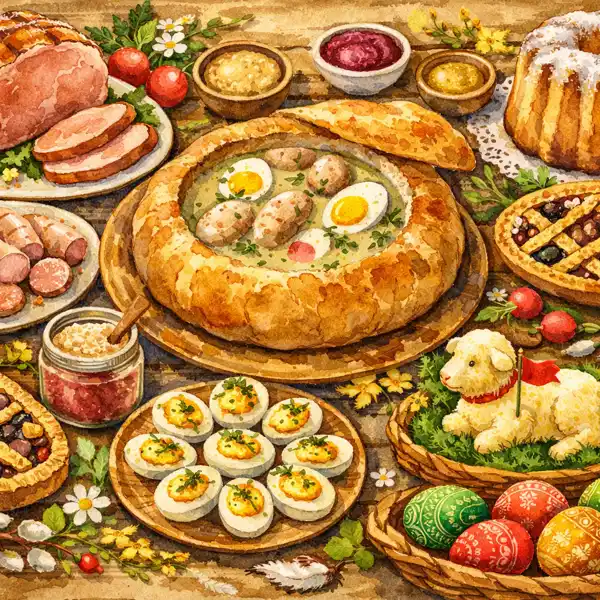
After forty days of Lenten fasting — no meat, reduced meals, a general air of penitential discipline — Wielkanoc (vee-el-KAH-nots) arrives like a released pressure valve. The table does not feature carefully counted dishes. It features everything. Hams, sausages, pâtés, eggs in every conceivable configuration, horseradish on all of it, soup in bread bowls, and then an entire separate universe of desserts.
Unlike the solemn sit-down format of Wigilia at Christmas, Easter is a grazing event — a cold buffet plus hot soups, laid out from morning and visited repeatedly throughout the day. Christmas is meatless. Easter is the opposite. After forty days of abstinence, the table makes its point with enthusiasm.
This is not a meal. This is a reckoning. Lent had it coming.
The Greatest Hits — Dishes You'll Find Everywhere
Every Polish Easter table, regardless of region or family, has certain non-negotiables. Skip any of these and you're just having a Sunday lunch with ambitions.
Żurek (Fermented Rye Soup)
The undisputed king of Polish Easter. Żurek (ZHOO-rek) is built on zakwas — a fermented rye flour starter prepared days in advance, tangy enough to make your face do interesting things on first taste. Seasoned with garlic and marjoram, mounted on a meat broth base, and served in hollowed bread bowls with sliced hard-boiled egg and white sausage floating inside.
The żurek has a comeback story. On Good Friday, the old tradition was to ceremonially smash the clay żur pot and hang the herring from a tree for "ruling over meat during Lent." Both were symbolically sentenced. The żurek returns on Easter Sunday morning — and nobody's complaining.
In the Tatra Mountains, żurek's mountain cousin appears: chrzonica — a horseradish-based soup of considerable intensity. If you can eat it without tearing up, the highlanders will quietly question your constitution.
Biała Kiełbasa (White Sausage)
The Easter sausage. Biała kiełbasa (BYAH-wah kyew-BAH-sah) is an unsmoked, uncooked fresh pork sausage seasoned with salt, pepper, garlic, and marjoram. It's sold raw and cooked fresh for the holiday — a seasonal food you eat at Easter, not in July. Those are the rules.
On the table: boiled with horseradish, baked with apples and onions, or floating inside żurek. Its aroma is, for most Poles, simply the smell of Easter. If you're of Polish descent and the scent of biała kiełbasa doesn't stir something in you, this may be worth exploring.
Szynka (Ham)
Baked in one magnificent piece or sliced cold — szynka is Easter's great supporting actor. Served with grated horseradish, because horseradish is present at every Easter event whether you specifically invited it or not. (It has a standing invitation.)
The Wielkopolska region takes ham further than anyone else, wrapping it in shortcrust pastry: szynka w cieście. An Easter contribution so quietly magnificent it deserves its own category.
Eggs — In Every Configuration
Jajka appear hard-boiled in the basket, stuffed (jajka faszerowane) with mushroom filling or horseradish-beetroot, quartered in żurek, folded into sałatka jarzynowa, tucked inside meatloaf. If it can hold an egg, it will.
Ćwikła z Chrzanem (Horseradish-Beetroot Relish)
Dark crimson, aggressively spicy, served alongside every cut of meat. Ćwikła (CHVEEK-wah) is the condiment equivalent of a structural wall. Remove it and the entire food architecture wobbles.
Chrzan (Horseradish)
Grated, fresh, served straight. The inseparable companion of every Easter meat. One of the items in the święconka basket — where it represents the bitterness of Christ's sacrifice. It will make you cry. This is considered appropriate.
Pasztet (Pâté)
Baked terrine of pork, beef, veal, and liver — time-consuming enough to be reserved for holidays, impressive enough to be worth it. Regional versions: fish pâté along the Baltic coast, rabbit in Silesia, pork with prunes in Mazowsze.
Sałatka Jarzynowa (Vegetable Salad)
Cooked carrots, potatoes, parsley root, celery root, peas, pickled cucumbers, hard-boiled eggs, and mayonnaise. Every family believes their recipe is the correct one. They are all correct. This is not a contradiction.
Mięso w Galarecie (Meat in Aspic)
Pork or veal set in savoury gelatin. Some consider it an act of culinary precision. Others quietly move it to the edge of their plate. It shows up regardless, like an elderly relative with strong opinions and zero interest in your preferences.
Śledź (Herring)
The herring was symbolically executed on Good Friday for its crimes against meat during Lent. Its appearance on the Easter table is therefore either a comeback or a haunting, depending on your outlook. Prepared in oil, in cream, in vinegar — always present.
Desserts — Where Easter Gets Very Serious
Babka Wielkanocna (Easter Babka)
The name literally means "grandmother." The shape resembles an old woman's gathered skirt. The temperament is fully earned.
A rich yeasted brioche-style dough packed with rum-soaked raisins and candied citrus peel, achieving its colour from up to fifteen egg yolks. Re-read that. Fifteen.
Opening the oven while it bakes is strictly forbidden. Loud noises near the kitchen are not tolerated. Walking heavily across the floor at the wrong moment is considered sabotage. Dropping the finished babka is a household crisis from which the baker may not emotionally recover until the following year. Kitchens go silent for the last twenty minutes. This is not a suggestion.
Some bakers produce a three-coloured babka — lemon, chocolate, and poppy seed braided together. These bakers are showing off. This is also acceptable.
Mazurek (Easter Tart)
Absolutely, exclusively an Easter dessert. Mazurek exists only at this time of year. A thin shortcrust base lavishly topped with dulce de leche, rose jam, nut cream, or fruit preserves, then decorated with dried fruits, nuts, and icing. The decoration is not optional.
Food historians suggest it may have arrived from Turkey in the 17th century. The classic varieties: kajmakowy (dulce de leche), różany (rose jam), orzechowy (nut cream). None available in July. This is part of what makes them special.
Sernik (Cheesecake)
Made with twaróg — Polish fresh curd cheese, which produces a texture that grocery-store cream cheese cannot replicate. Dense, barely sweet, laced with raisins. Sits alongside the more theatrical babka and mazurek without apology.
Pascha Wielkanocna (Easter Pascha)
Cottage cheese, butter, eggs, sour cream, vanilla, raisins, almonds, and candied fruits, pressed into a pyramid mould and unmoulded cold. Particularly beloved in Podlasie, where eastern influences shaped the Easter table.
Makowiec (Poppy Seed Roll)
One of the very few desserts that appears at both Easter and Christmas — a rare ambassador between the two feasts. At Easter it simply turns up because it is delicious and welcome.
A Culinary Road Trip: Seven Regions, Seven Opinions
Poland is not one culinary monolith — it's several centuries of history and fierce regional pride, all expressed through food. Think of it as several delicious countries in a trench coat, each convinced their Easter table is the correct one.
Podhale (The Tatra Mountains)
The highlanders do nothing at half-measure.
Signature Dishes:
Chrzonica — Horseradish soup of considerable aggression. The highlanders consider this the appropriate level of intensity.
Lamb — One of very few regions where lamb actually appears on the Easter table. The mountains raise sheep; the sheep become part of the feast.
Oscypek and bundz (sheep cheeses) — These go in the święconka basket alongside homemade bread. A family in full regional góralski dress carrying a basket with smoked sheep cheese to a centuries-old wooden church is one of the more quietly extraordinary sights of Polish Easter.
Moskole — Potato pancakes with bryndza sheep cheese. If it's not broken, the highlanders don't fix it.
Regional Quirk: Faith meets folklore meets sheep cheese. If Easter has an aesthetic, Podhale is it.
Silesia (Śląsk)
Silesians have strong opinions about most things, and Easter food is no exception.
Signature Dishes:
Rabbit pâté — More common here than anywhere else in Poland.
Smoked regional kiełbasa — Some households smoke their own; others have arrangements with a butcher whose identity is treated as a matter of family security. Do not ask a Silesian to share their butcher.
White sausage, dual tradition — Both Polish biała kiełbasa and the German Weißwurst appear, reflecting the region's dual heritage. Two types. Both consumed. Nobody sees a contradiction.
Regional Quirk: In Racibórz, the Rezurekcja procession is conducted on horseback. The Easter breakfast that follows is a meal you have earned in the saddle. For the Turki tomb guards, see the Holy Week guide.
Wielkopolska (Greater Poland)
Refined without being pretentious. Substantial without being excessive. Always served with the quiet confidence of a region that believes it does things correctly.
Signature Dishes:
Szynka w cieście — Baked ham wrapped in shortcrust pastry. Wielkopolska's flagship Easter contribution. The pastry seals in the juices. It sounds simple. It is not. It is magnificent.
Easter barszcz na mięsie — Red beet soup on a meat broth base, served with quartered eggs. Elegant in colour, deeply satisfying.
Regional Quirk: Wielkopolska insists its ham preparation is superior to all other regional approaches. This position is stated calmly and repeatedly. The region may well be right.
Kashubia (Kaszuby)
Its own language (officially recognised), its own folk art, its own Easter table that gently declines to be described as simply "Polish."
Signature Dishes:
Praznica — Scrambled eggs with bacon. Not complicated. Deeply satisfying. The rest of Poland frets over żurek; Kashubia eats eggs with bacon and has no regrets.
Roasted fish with plums and potato dumplings — Sweet-savoury, coastal, a reminder that Kashubia faces the Baltic.
Regional Quirk: Easter Sunday evening in Kashubia is the traditional time for conciliation between families — the formal determination of a bride's dowry. Simultaneously the most solemn Christian feast and a practical property negotiation. The Kashubians saw no contradiction. Practical people.
Podlasie (Eastern Borderlands)
Lithuanian, Belarusian, and Ukrainian fingerprints alongside Polish ones. The food tells the history of a borderland where empires overlapped.
Signature Dishes:
Pascha — The cottage cheese pyramid is the centrepiece here, not one item among many.
Buckwheat and sour cream dishes — Not a supporting grain here; a star ingredient.
Regional Quirk: A single Easter table can carry four cultures simultaneously.
Lower Silesia (Dolny Śląsk)
A table unlike any other, telling a specific 20th-century story. After WWII, displaced communities from the Eastern Borderlands (Kresy) and Lemko people resettled here, bringing their food traditions.
Signature Dishes:
Round decorated Easter bread — Brought by Kresy families, found almost nowhere else.
Kysylica — The Lemko version of żurek: thick, sour, with bay leaves, allspice, and cumin.
Regional Quirk: A compressed map of forced migration on one table — a culinary testament that few food guides acknowledge.
Mazowsze (Mazovia)
The capital area claims the definitive version of several dishes. This is a Polish regional tradition.
Signature Dishes:
Pasztet z wieprzowiny ze śliwkami — Pork pâté with prunes. Family recipes treated as intellectual property. Mazovian grandmothers will explain at length why the prunes make all the difference. They are not wrong.
Żurek w chlebie — Warsaw claims the best version. The rest of Poland has thoughts.
Regional Quirk: Mazovian legend holds that when Mary Magdalene found the empty tomb and returned home rejoicing, all the eggs in her basket had turned red. Red eggs remain particularly significant here.
The Old Polish Easter Feast — A Historical Note
In magnate households of the 16th-17th century, the post-Rezurekcja breakfast included hams, sausages, a whole baked piglet, arrays of mazurki and tortes, and — not overlooked — vodka, mead, beer, and wine in quantities reflecting the relief of forty days' fasting. The more impatient szlachta were reportedly already raiding the table on Holy Saturday evening. Some things never change.
Mikołaj Rej (1505-1569) recorded creative food beliefs: blessed sausage protects against snake bites, horseradish from fleas, hazel grouse from imprisonment. The Renaissance's version of superfoods — the claims merely ran in a different direction.
The French cartographer Guillaume de Beauplan recorded a priest collecting 5,000 eggs in two hours on Good Friday. Remarkable logistical coordination.
FAQ
What do Polish people eat at Easter?
A cold buffet plus hot soups, grazed from morning. Essentials: żurek, biała kiełbasa, baked ham with horseradish, egg dishes, ćwikła, pasztet, sałatka jarzynowa. Desserts: babka, mazurek, sernik, makowiec.
What is żurek?
Fermented rye soup — tangy, garlicky, served in bread bowls with hard-boiled egg and white sausage. Built on a starter called zakwas. The mountain variant (chrzonica) uses horseradish and is not for the faint of palate.
What is mazurek?
A uniquely Polish Easter tart — thin shortcrust, lavishly topped, elaborately decorated. Possibly arrived from Turkey in the 17th century. Classic versions: kajmakowy, różany, orzechowy.
What is babka and why is everyone nervous about it?
A tall yeasted Easter cake with up to fifteen egg yolks. Its reputation for temperament is earned: opening the oven causes collapse; loud noises are sabotage; dropping the finished cake is a crisis. Every baker approaches it with something between confidence and dread.
For the traditions surrounding this table — the Holy Week guide, the ancient roots, the water fight that follows — see the complete Wielkanoc guide.
Smacznego i Wesołego Alleluja!
