




Where Eggs Are Weapons, Palms Reach Twelve Stories, and an Entire Country Picks a Water Fight on Monday
If you grew up in a Polish household, you probably assumed Christmas was the main event. Understandable — it gets more international press. But back in Poland, Wielkanoc (pronounced vee-el-KAH-nots) is considered the more important holiday. More significant in the liturgical calendar, more layered culturally, and significantly more likely to involve someone throwing a bucket of cold water at your head before breakfast.
Wielkanoc literally means "Great Night" — the night of Christ's resurrection. But calling it "a night" is like calling the Olympics "a race." The celebrations sprawl across an entire week (Wielki Tydzień, or Holy Week), where almost every day comes with its own rituals, its own rules, its own food, and its own superstitions that will make you count your eggs three times while nervously checking whether the horseradish is strong enough.
Palm Sunday kicks things off with twelve-story flower constructions that would make a florist faint. Holy Saturday brings the sacred basket blessing. Easter Sunday is the triumphant return of meat after six weeks of Lenten fasting. And Easter Monday? The whole country has a water fight. On purpose.
This guide is your overview of all of it — what Wielkanoc is, how it compares to Christmas, what happens each day, what you eat, what you decorate, and why there are two ancient Kraków festivals that most Poles outside of Kraków have only vaguely heard of.
Christmas vs Easter: How They Actually Compare
If you know Wigilia — the meatless Christmas Eve dinner — Easter is its mirror image. The contrasts tell you everything:
Christmas is anticipatory — you're waiting for something. Easter is triumphant — the fast is over, and the table proves it. One Pole described it this way: Christmas is when you behave yourself. Easter is when you get your reward.
Pagan Roots: There's Something Older Underneath
Scratch the surface of almost any Polish Easter tradition and you'll find something pre-Christian underneath. The decorated eggs, the water-throwing, the burning effigies, the bonfires, the pussy willow blessed in church — none of these started with Christianity. Poland's Easter is a fusion of Catholic liturgy and ancient Slavic spring rites called Jare Gody, a multi-day fertility festival that predates the baptism of Poland by centuries.
The Church absorbed the existing calendar, gave the participants new names, and kept the sensory experience intact. The spring effigy that got burned? Still gets burned — it's just Judas now instead of the winter goddess Marzanna. The decorated eggs exchanged at hilltop feasts? Now they symbolise the resurrection. The Monday water fight? Mapped onto Christian baptism.
Poland didn't replace paganism with Christianity — it wrapped Christianity around paganism like a decorated eggshell. The result is a holiday that carries both layers, visible if you know where to look.
For the full story, head to The Pagan Roots of Polish Easter.
The Week at a Glance
Wielki Tydzień (Holy Week) is one of the densest ritual calendars in European Christian tradition. Here's the overview, with the full guide in the Holy Week traditions article.
Palm Sunday (Niedziela Palmowa): No palm trees in Poland, so Poles build towering alternatives from pussy willow, boxwood, dried flowers, and crepe paper. The village of Lipnica Murowana holds an annual competition — the record palm reached 37.78 metres. Blessed palms protect homes from lightning all year.
Holy Thursday (Wielki Czwartek): Church bells go silent until Holy Saturday. Boys run around church with wooden rattles — kołatki — to fill the silence. The bigger the rattle, the better. In some southeastern regions, an effigy of Judas is burned — which maps neatly onto the older Marzanna burning ritual.
Good Friday (Wielki Piątek): The most solemn day. Families visit elaborately decorated tombs of Christ. In parts of Małopolska, bachelor men in Ottoman Turkish-style uniforms guard the tomb — a tradition tracing to King Jan Sobieski's victory at the Battle of Vienna in 1683.
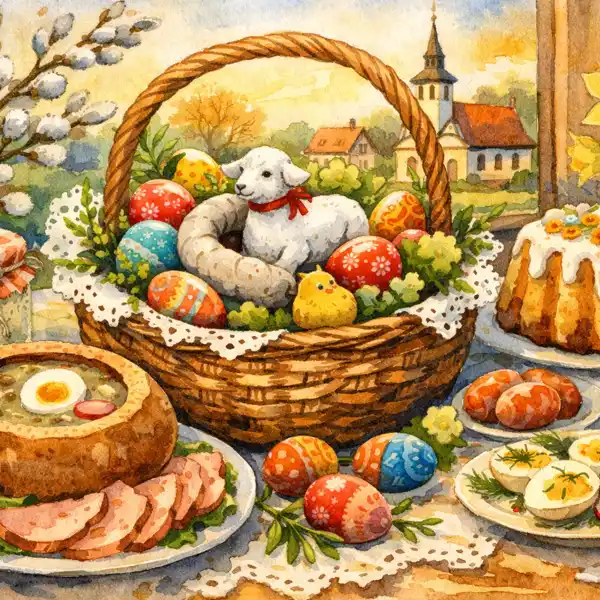
Holy Saturday (Wielka Sobota): The day of the święconka — the blessed Easter basket. Families bring carefully arranged baskets of food to church for the priest's blessing. The care people put into their baskets is a quiet form of devotion.
Easter Sunday (Wielkanoc): The Rezurekcja procession begins before sunrise. The priest carries the Eucharist around the church three times while bells ring for the first time since Thursday. Then: Easter breakfast, begun by sharing the blessed egg and exchanging "Wesołego Alleluja!"
For the day-by-day deep dive, visit Polish Easter Traditions: Holy Week Day by Day.
The Food: Forty Days of Waiting, Magnificently Rewarded
After six weeks of Lenten fasting, the Polish Easter table arrives like a released pressure valve. It's a magnificent cold buffet supplemented by hot soups, assembled the day before and grazed through from morning to afternoon.
The centrepiece is biała kiełbasa (white sausage) — an unsmoked, uncooked pork sausage so specifically associated with Easter that its aroma is simply the smell of the holiday for most Poles. Then come the hams, the pâtés, the mountains of hard-boiled eggs, the horseradish in every possible form, and the żurek — that glorious fermented rye soup served in a bread bowl.
The żurek has a comeback story. On Good Friday, the old tradition was to ceremonially smash the clay pot of żur and hang the herring from a tree for "ruling over meat during Lent." Both were symbolically sentenced. The żurek returns on Easter Sunday morning — and nobody's complaining.
The desserts deserve their own section. Babka (the Easter bundt cake) is so temperamental that opening the oven while it bakes is forbidden. Kitchens go silent for the last twenty minutes. Dropping the finished babka is a household crisis from which the baker may not emotionally recover until the following year. Mazurek, the flat Easter tart, may have arrived in Poland from Turkish traders in the 17th century.
For the complete food tour, see Polish Easter Cuisine: A Regional Tour.
Pisanki: The Art of the Decorated Egg
Pisanki (pee-SAN-kee) — Polish decorated Easter eggs — have a documented history of over a thousand years. Archaeologists found decorated clay eggs in the ruins of a Slavic stronghold near Opole, dating to the 10th century. But the tradition is far older than Christianity in Poland: eggs were part of the pre-Christian spring festival Jare Gody.
The word "pisanki" comes from pisać — "to write." The eggs are written, not painted. The most traditional technique uses a metal-tipped pen called a pisak to apply hot wax before the egg is dipped in dye. It takes genuine skill. Your first attempt will not look like the photos. Keep going.
Decorating Techniques
| **Skrobanki / Drapanki** | Egg dyed first, then pattern scratched into the shell with a sharp tool | Łowicz, Opoczno, Kielce regions || **Oklejanki** | Coloured paper, yarn, fabric, or straw cutouts applied to the shell | Various regions || **Wydmuszki** | Blown-out shells for permanent display | Nationwide |Superstitions Around Eggs
- 🔴 Red-dyed eggs were believed to have magical properties, especially in matters of love — an ancient Slavic belief predating Easter
- Historically, women did all egg decorating. If a man entered the room, a ritual salt purification was reportedly required
- 💝 A girl presenting a bachelor with a beautifully painted pisanka was making a declaration of romantic interest
- 🌱 Blessed eggs buried at the corners of a field were believed to guarantee a good harvest
- A Mazovian legend holds that when Mary Magdalene found the empty tomb and returned home rejoicing, all the eggs in her basket had turned red
The Egg Tapping Tournament
Egg tapping (stukanie jajkami) is competitive and taken seriously. Each player selects a champion egg. Two players tap narrow ends together; the one whose egg cracks loses. The last unbroken egg wins its owner good luck for the year. Selection criteria are closely guarded. There are people who assess egg geometry. Nobody admits to having a strategy. Everyone has a strategy.
Emaus and Rękawka: Kraków's Ancient Easter Week
Emaus — Easter Monday, Kraków
Since at least the 18th century, the Zwierzyniec district has hosted the Emaus fair — craft stalls, regional food, carnival games, folk music, and the distinctive Emaus trees — decorated symbolic spring trees tracing back to pre-Christian rites. Tens of thousands visit. Śmigus-Dyngus water attacks between the stalls are part of the experience.
Rękawka — Easter Tuesday, Kraków
Held at the Krakus Mound — Kraków's oldest man-made structure — it's connected to pre-Christian commemoration of the dead. Modern Rękawka involves medieval re-enactments, knight combat, Slavic spring rituals, archery, and bonfires. One of the few events where you can watch a pagan spring ceremony and a medieval sword fight in the same afternoon.
Śmigus-Dyngus: It Needs Its Own Article
Śmigus-Dyngus — also called Lany Poniedziałek (Wet Monday) — is Easter Monday: the entire country turns into a water fight. An ancient Slavic purification rite that has survived six medieval bans. There's much more to say — the folklore, the diaspora celebrations in Buffalo — which is why it has its own article.
Modern Easter in Poland (and in the Diaspora)
The Easter Bunny arrives, eventually. The zajączek is a relatively recent import, becoming popular with young Polish parents. It doesn't have the deep roots of the święconka basket, but it's arriving fast.
Rzeżucha (garden cress) is one of the most characteristically Polish Easter decorations. Grown on damp cotton wool, it's fast-sprouting, edible, and its peppery taste is, for many Poles, simply the flavour of Easter. If you want a low-effort way to bring Polish Easter home: start here.
The butter/sugar lamb (Baranek wielkanocny) appears in every store — moulded in the shape of a lamb symbolising the Risen Christ. Whether it's actually edible is a matter of ongoing national debate. Its flavour has been described, charitably, as "decorative."
For diaspora communities, Wielkanoc often becomes the anchor holiday — the święconka basket ritual translates remarkably well to any city with a Polish parish. Show up early on Holy Saturday. The parking fills fast.
The Bigger Picture
Polish Easter is Christianity layered on top of Slavic spring rites, held together with food, superstition, and water. It spans a full week, touches every sense, and refuses to let either the pagan past or the Catholic present dominate entirely. The spring fertility egg became the resurrection egg. The winter goddess's effigy became Judas. The purification water fight became a baptism symbol. And all of it — the wax-resist eggs, the 37-metre palm, the Turkish-uniformed tomb guards, the sour rye soup in a bread bowl — belongs to a single continuous tradition running for over a thousand years.
Explore the full Easter cluster:
- The Pagan Roots of Polish Easter
- Polish Easter Traditions: Holy Week Day by Day
- Polish Easter Cuisine: A Regional Tour
- Śmigus-Dyngus: Poland's Wildest Holiday
FAQ
Q: What does Wielkanoc mean and how do you pronounce it?
A: Wielkanoc (vee-el-KAH-nots) literally means "Great Night" — referring to the Easter Vigil. The term now covers the entire Easter period, from Palm Sunday through Easter Monday.
Q: Is Easter more important than Christmas in Poland?
A: Liturgically, yes. Culturally, both holidays are treated with complete seriousness. Inside Poland, Wielkanoc wins on ritual density — an entire week, every day with its own traditions. If forced to choose, Poles usually say Easter.
Q: What is the święconka basket and what goes in it?
A: Święconka (shvyen-TSON-kah) is the Easter basket brought to church on Holy Saturday. It contains: decorated eggs, bread, white sausage, ham, salt, horseradish, a butter or sugar lamb, babka or mazurek, and a candle. Each item carries specific symbolism. The blessed contents are eaten at Easter breakfast, beginning with the egg.
Q: What are pisanki?
A: Decorated Easter eggs made using a wax-resist technique — hot wax applied with a pisak pen, then dipped in dye. Other types include kraszanki (single-colour dye), skrobanki (scratch-decorated), and oklejanki (applied decorations). All casually called "pisanki." Purists will correct you.
Q: Do Polish people really do Śmigus-Dyngus?
A: Yes. Easter Monday is a genuine national water fight — streets, parks, balconies. The tradition is ancient, connected to Slavic purification rituals and possibly to Mieszko I's baptism in 966 AD. Polish diaspora communities in Buffalo and Chicago have kept it alive on a large scale. Full story in the Śmigus-Dyngus guide.
Q: What can I do at home in the diaspora?
A: The święconka basket needs only a basket and a Polish parish. Pisanki supplies are available online. Żurek can be made from a starter kit. Rzeżucha grows in a week on a damp cloth. And Śmigus-Dyngus requires only water and willing neighbours.
